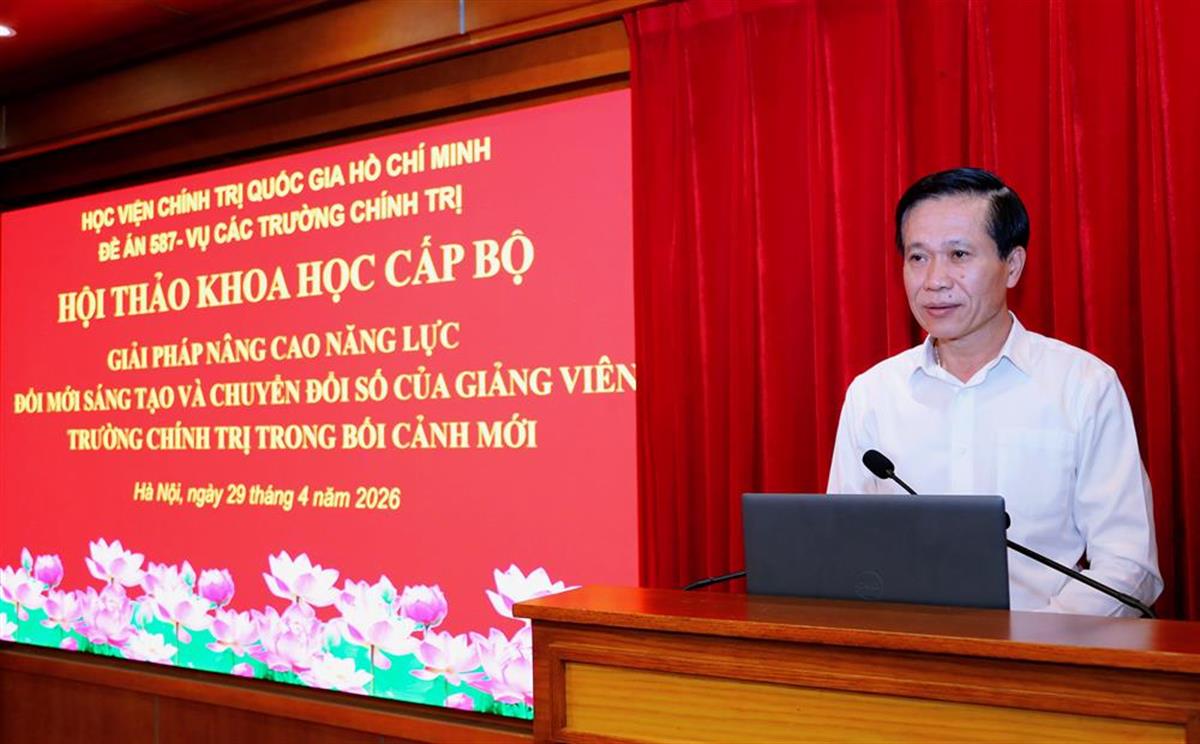
 Assoc. Prof. Dr. Hoang Phuc Lam, Deputy Secretary of the Party Committee, Vice President of Ho Chi Minh National Academy of Politics delivered remarks at the conference
The conference was co-chaired by Assoc. Prof. Dr. Hoang Phuc Lam, Deputy Secretary of the Party Committee, Vice President of Ho Chi Minh National Academy of Politics; Dr. Nguyen Thi Thanh Nhan, Director of the Political Schools Department; and Dr. Ngo Ngan Ha, Deputy Director of the Organization and Personnel Department and Chief of Office for Project 587. The participants of the event were leaders of the Academy and municipal and provincial political schools as well as scientists, experts, lecturers, and managers in the political theory training and fostering system.
This scientific forum aimed to exchange and clarify theoretical and practical issues arising in the process of improving the quality of the teaching staff — a key factor determining the effectiveness of training and fostering officials in the context of digital transformation and innovation becoming inevitable trends.
In her introductory speech, Dr. Nguyen Thi Thanh Nhan emphasized that innovation and digital transformation have become key drivers of growth and development as the world is entering a period of profound transformation. For political schools, the question is no longer “whether or not to undergo digital transformation,” but rather to what extent, at what speed, and under what model to meet the training and development needs of cadres in the new context. Innovation plays a fundamental role in thinking, acting as the “key” to digital transformation, ensuring it goes beyond simply applying technology and becomes a method of creating new values in political theory education.
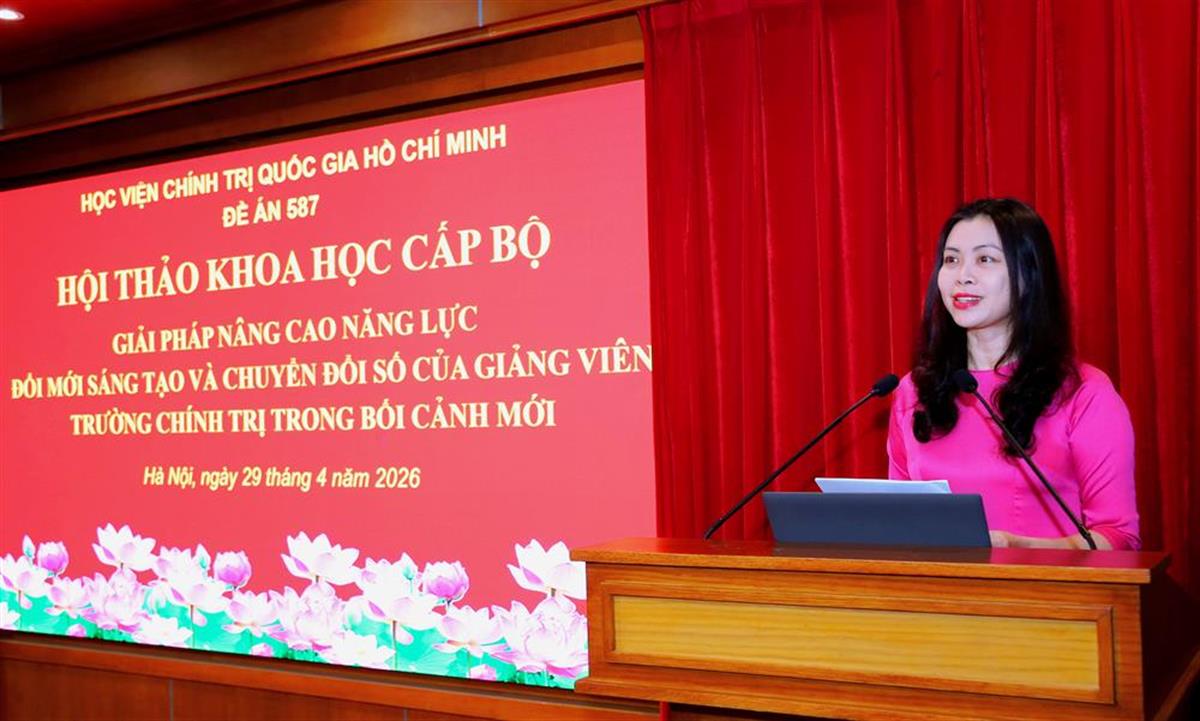 Dr. Nguyen Thi Thanh Nhan, Director of the Political Schools Department, made an introductory speech
She also suggested many groundbreaking directions with the emphasis on the need for a fundamental change in the philosophy of lecturer training towards encouraging critical thinking, abilities to raise problems, and problem-solving skills. Simultaneously, she referred to the demand for the creation of “pedagogical experimentation spaces” where the teaching staff can freely create and experiment with their new teaching methods, build a peer learning community among lecturers, and develop an integrated competency framework encompassing political, pedagogical, digital, and innovative competencies. These directions are not only significant improvements but also essential conditions for the survival of the political school system in the new era.
The conference was organized into two main working sessions according to the agenda. The first session focused on analyzing the current situation and challenges for the innovation and digital transformation capabilities of lecturers at political schools. Outstanding presentations on the requirements for developing lecturer’s capabilities, the application of artificial intelligence and big data in teaching political theory as well as the opportunities and challenges in digital transformation for the cadre training and fostering system.
The second one centered on proposing solutions to enhance the innovation and digital transformation capabilities of lecturers in the new context, with presentations on building a digital ecosystem, the role of leaders in promoting innovation, and building a model of a “digital lecturer – an innovative lecturer”. The presentations provided abundant scientific arguments and practical experience, contributing to clarifying feasible directions in the future.
During the discussions, the participants exchanged their opinions openly and frankly, focusing on many important issues. One of them was the gap between development requirements and the implementation capacity of the teaching staff. While the new context demands digital thinking skills, policy analysis skills, and the ability to handle complex situations, teaching methods in many places are still heavily focused on one-way transmission, lacking interaction and connection to practice. This leads to a situation where “technologies are available but have not been mastered yet,” and “digitalization follows old patterns” instead of creating new values.
Identifying systemic bottlenecks in digital transformation, the participants said that these included a lack of synchronized digital infrastructure and ecosystems; a scarcity of interactive digital learning materials; insufficient incentive mechanisms and policies to encourage innovation; and a lack of close alignment between lecturer evaluation and training and requirements on competency development in the new context. Particularly, many opinions emphasized the crucial role of leaders in fostering an innovative environment and promoting a spirit of bold thinking, action, and accountability among the teaching staff.
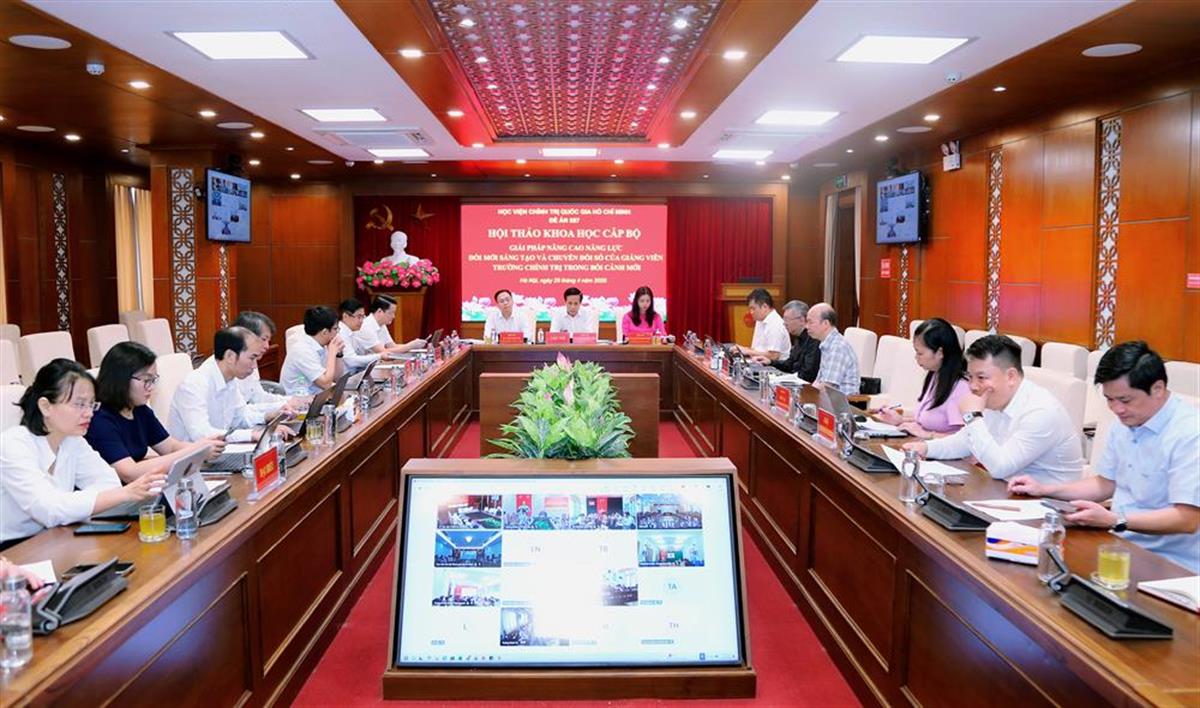 A view of the conference
Based on the analysis of the current situation, the participants proposed many practical and highly feasible solutions. Among them, the most prominent recommendation was the need to shift strongly from the logic of “knowledge transmission” to “capacity building”; building a synchronized digital ecosystem linked to data, learning materials, and technology platforms; developing a learning community and knowledge sharing among lecturers; and reforming the evaluation mechanism to focus on creating values rather than simply meeting standards. Simultaneously, it was necessary to strengthen the digital skills and innovation capabilities of lecturers, in association with the practical needs of each locality.
In his conclusion remarks, Assoc. Prof. Dr. Hoang Phuc Lam affirmed that the presentations approached issues systematically and comprehensively, from theory to practical implementation. Based on these, the conference reached a fundamental understanding of lecturers’ role in the new context. The teaching staff’s competence was no longer a supporting factor but has become a decisive condition for the quality of the cadre training and fostering. Innovation was not a separate skill but a pervasive competency throughout all pedagogical and research activities. This competency needs to be integrated with digital and professional competencies. If the curriculum is the framework and the institutions are the foundation, then the lecturers are the driving forces of the system.
From these practices, he emphasized the need for comprehensive innovation in thinking, methods, and operating mechanisms. It is necessary to make a strong shift from the logic of “knowledge transmission” to “capacity building” in training and fostering. Lecturers should not only be teachers but also designers, guides, and promote critical thinking among learners. Improving lecturer capacity must be linked to innovation in curriculum, methods, and assessment. At the same time, a synchronized digital ecosystem needs to be built to create a new operating environment for knowledge. This is a crucial condition for the digital transformation to become truly effective.