The event was co-chaired by Assoc. Prof. Dr. Le Hai Binh, member of the Party Central Committee, Standing Vice President of the Ho Chi Minh National Academy of Politics, Deputy Head of the Steering Committee 35, and Assoc. Prof. Dr. Lieutenant General Trinh Ngoc Quyen, Director of the People’s Security Academy.
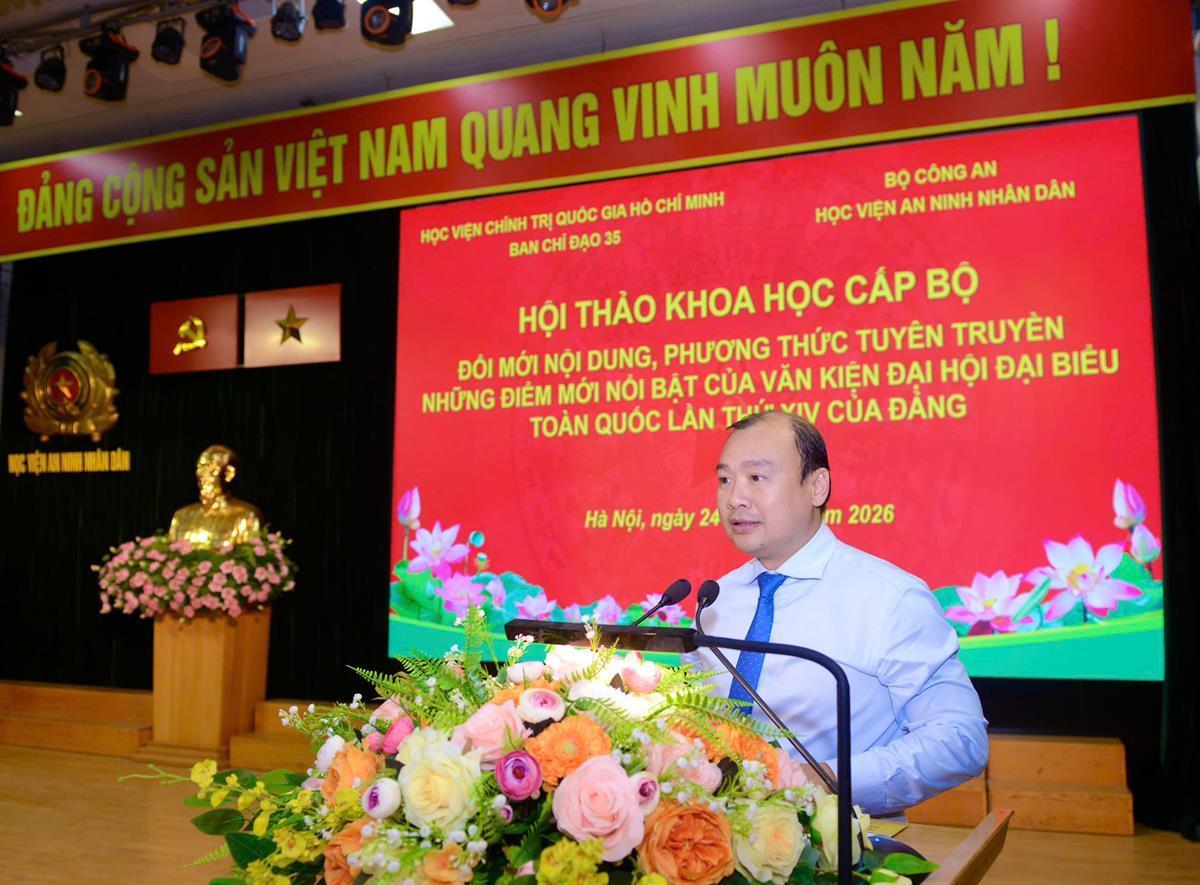 Assoc. Prof. Dr. Le Hai Binh, member of the Party Central Committee, Standing Vice President of the Ho Chi Minh National Academy of Politics and Deputy Head of the Steering Committee 35, delivered remarks at the conference
The participants of the conference were Prof. Dr. Colonel Nguyen Truong Tho, Vice Director of the People’s Security Academy, leaders and scientists from units of the Ho Chi Minh National Academy of Politics and the Ministry of Public Security.
The event was an important scientific forum for scientists and managers to exchange and clarify theoretical and practical issues, and simultaneously to propose practical solutions to improve the effectiveness of communication. These have contributed to the early implementation of the Party’s 14th Congress Resolution, in connection with the task of fighting and refuting bad and toxic information, and firmly protecting the Party’s ideological foundation.
In his welcoming remarks and opening speech, Assoc. Prof. Dr. Lieutenant General Trinh Ngoc Quyen emphasized that the 14th National Congress of the Party was an event of especially important significance, shaping the country’s development direction in a new era—the era of development and rise of the Vietnamese nation. The major viewpoints, policies, and orientations established in the Congress documents serve as a guiding principle for the entire political system, not only for the 2026–2030 period but also toward a vision to 2045, with the goal of building Vietnam into a developed socialist country with high income, prosperity, civilization, and happiness.
In this context, Assoc. Prof. Dr. Lieutenant General Trinh Ngoc Quyen affirmed affirmed that the communication and dissemination of the new and outstanding points of the Party’s 14th National Congress documents have been identified as an urgent task, of decisive significance in creating high unity in awareness and action throughout the Party, the people, and the armed forces. He said it is required to strongly innovate both the content and methods of communication, ensuring that the Party’s policies and viewpoints are conveyed deeply and convincingly to every cadre, Party member, and citizen, thereby creating a combined strength to promote national development rapidly and sustainably.
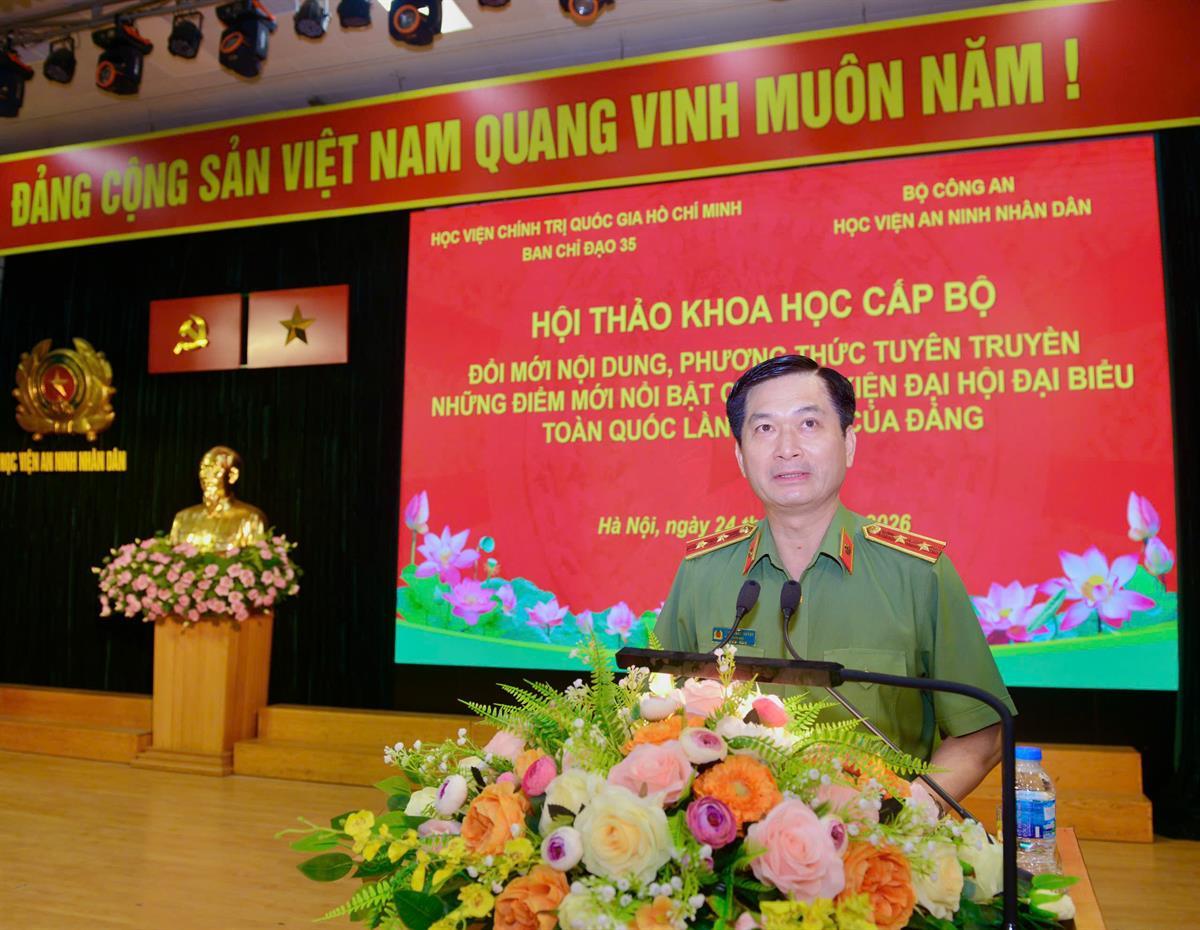 Assoc. Prof. Dr. Lieutenant General Trinh Ngoc Quyen, Secretary of the Party Committee and Director of the People’s Security Academy, delivered an opening speech at the conference
More than 60 presentations and opinions discussed at the conference focused on clarifying the “new points” and “breakthroughs” in the Party’s 14th National Congress documents; thereby clarifying the strategic vision, breakthrough thinking, and pivotal contents that will lead the country into a “new era of Vietnamese nation’s rise”. At the same time, the opinions also centered on deeply analyzing values such as “the people are the foundation,” the need to “be closer to the people,” as well as factors that inspire self-reliance, self-strength, and self-confidence throughout the Party and the people to realize the aspiration for developing the country amid a volatile international environment.
The participants spent much time discussing innovations in the content and methods of disseminating the Party’s 14th National Congress documents. They emphasized the need to ensure accuracy, militancy, and persuasiveness; to leverage the role of Party committees, political and social organizations, political theory lecturers, the press, and core forces. Strengthening the application of digital technologies and modern communication methods was identified as a crucial direction to enhance the effectiveness of dissemination and contribute to putting the Party’s 14th National Congress Resolution into practice.
The opinions also delved into finding solutions to the problem: How to innovate communication methods to ensure diversity, substance, and persuasiveness, especially in the context of the digital age, in order to make the content of the documents “permeate” into life and spread strongly to all levels of the population.
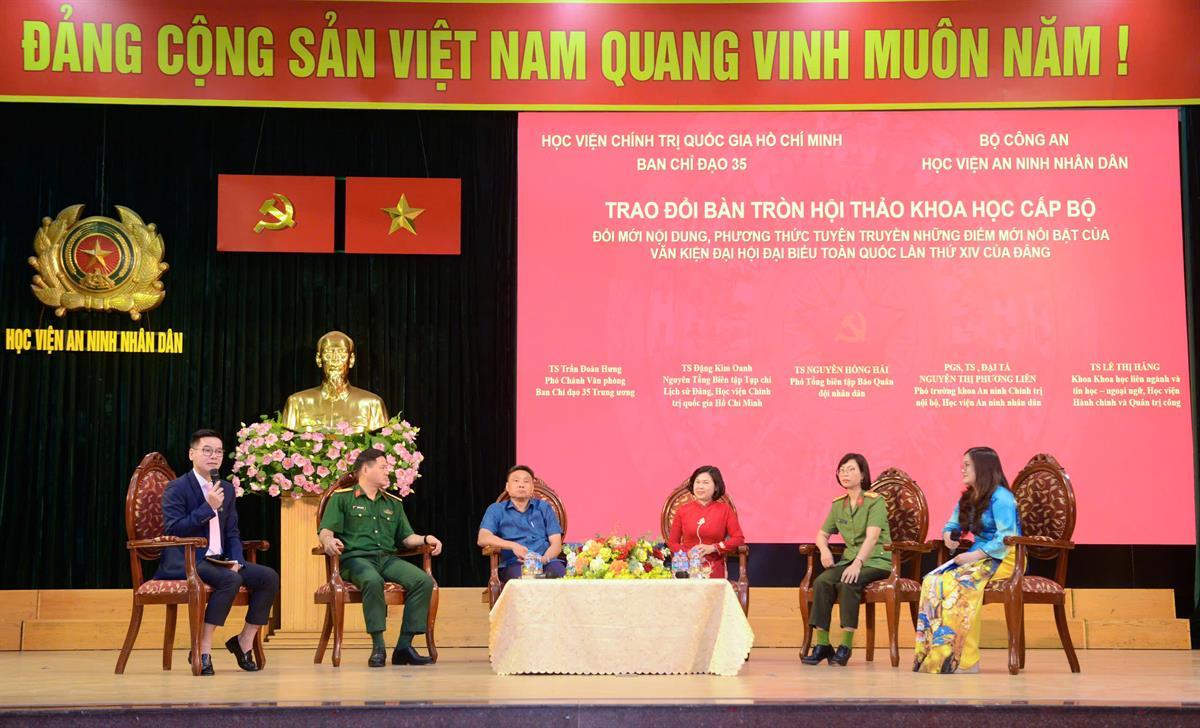 The roundtable discussion at the conference
In his concluding remarks, Assoc. Prof. Dr. Le Hai Binh affirmed that the results of the conference were the important foundation to continue innovating the content and methods of disseminating the outstanding new points of the Party’s 14th National Congress documents. Among them, it is necessary to apply the spirit of the Party’s 14th National Congress documents as an important “theoretical handbook” to combat and refute wrong and hostile viewpoints on a number of specific and new issues.
He emphasized the need to continue innovating the content and methods of communication in a practical and effective direction, focusing on clarifying new viewpoints and concepts linked to reality and suitable for each social group. These would ensure that the Party’s 14th National Congress documents have penetrated deeply in practice and become the basis for guiding the actions of each organization and individual.
Simultaneously, we must leverage the role of core communication “forces” including the press, the media, the armed forces, political theory lecturers, the Fatherland Front and socio-political organizations, and the reporters and communicators at the grassroots level; integrate the content of the documents into curricula and lectures, innovate the thinking on teaching political theory; and establish a mechanism for coordination and cooperation among these forces.
Particularly, it is necessary to accelerate digital transformation and the application of artificial intelligence, effectively utilize the Party and State’s digital platforms (VneID, the communication and mass mobilization application, the Party Member Handbook, websites and communication channels of the Steering Committee 35 at all levels, etc.), shifting from one-way communication to multidimensional interaction and measuring results.