The co-chairmen of the event were Assoc. Prof. Dr. Le Hai Binh, member of the Party Central Committee, Standing Vice President of the Academy, Dr. Dao Ngoc Bau, Director of the Academy’s Institute of Politics and International Relations, and Mr. Timo Rinke, the Resident Representative of FES in Vietnam.
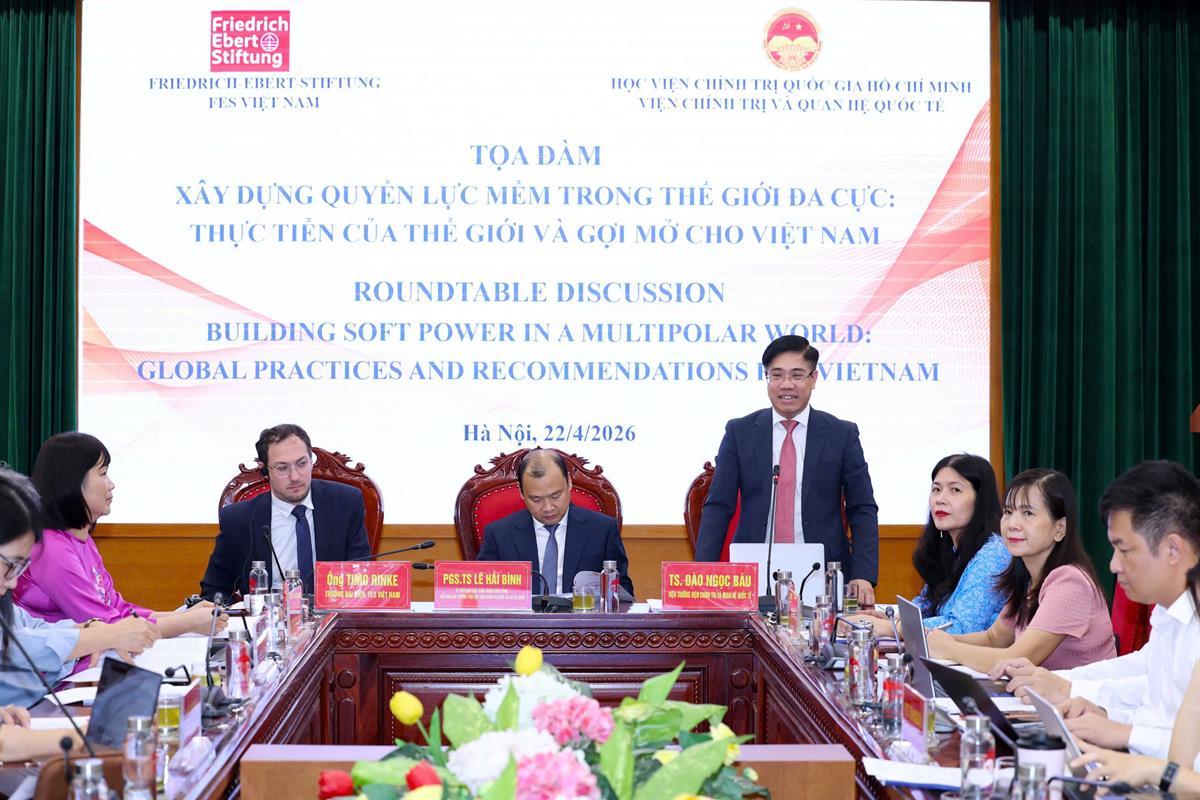 Co-chairmen of the roundtable discussion
The roundtable discussion is a practical activity that contributes to concretizing the research and implementation of the Party’s policies, especially Resolution No. 80-NQ/TW of the Politburo on cultural development and enhancing the nation’s position in the new period. It is also a forum for experts and scientists to exchange opinions and assess the context, share international experiences, and identify new trends, thereby proposing practical recommendations to enhance Vietnam’s position, image, and attractiveness in the coming time.
In his opening remarks, Assoc. Prof. Dr. Le Hai Binh emphasizes that the world is entering a profound transformation of the international power structure, shifting strongly from a unipolar to a more clearly defined multipolar and multi-centered world. In the context of increasingly fierce strategic competition among major powers, along with unpredictable geopolitical changes, scientific and technological advancements, and non-traditional security challenges, “soft power” is no longer a supplementary concept but has emerged as a crucial tool for nations to increase their influence and strengthen their position. Particularly, the surge of the fourth industrial revolution, digital transformation, and the green economy is creating an urgent need to reposition national power and international influence in the new world order.
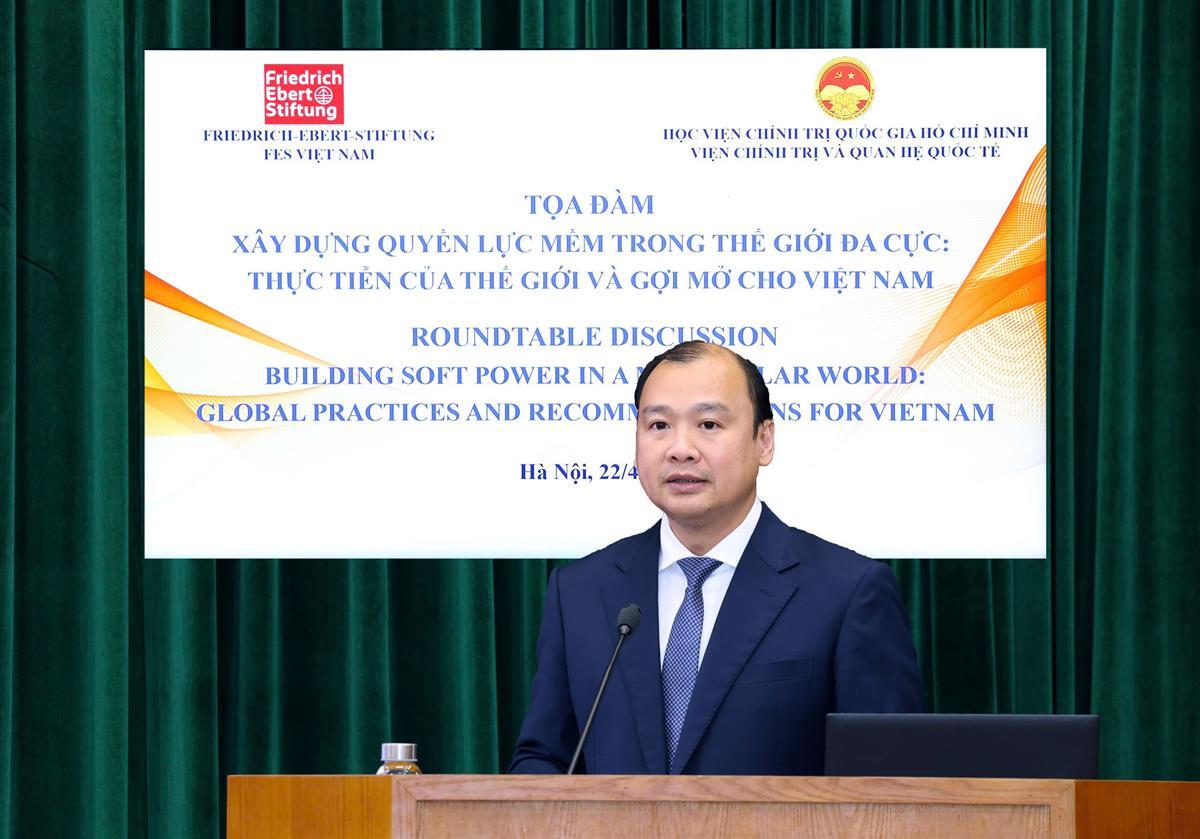 Assoc. Prof. Dr. Le Hai Binh, member of the Party Central Committee, Standing Vice President of the Academy, delivered opening remarks at the roundtable discussion
Addressing the positioning of Vietnam’s soft power, Assoc. Prof. Dr. Le Hai Binh affirmed that Vietnam’s soft power was formed from its national cultural identity, human values, and the achievements of the renovation process under the Party’s leadership since 1986. To realize the nation’s aspiration for progress in the new era, he believed that it was necessary to have a strategic vision and breakthrough policies, focusing on key issues such as elevating thinking about soft power; promoting cultural diplomacy and international integration; applying science and technology and digital transformation to promote the national image; and simultaneously developing internal strengths, placing people at the center, as the subject and driving force of development.
In his introductory speech, Mr. Timo Rinke, the Resident Representative of FES in Vietnam, affirmed the increasingly prominent role of soft power. He said that in the context of a world shifting towards a multipolar system and increasing strategic competition, the strength of each nation was measured not only by its economic or military potential but also by its ability to build trust, attractiveness, and international connectivity. For Vietnam, this was a matter of long-term strategic significance, as the country possesses many important advantages such as a rich cultural identity, positive achievements in socio-economic development, an open foreign policy, and the image of a stable, dynamic, and trustworthy nation.
Mr. Timo Rinke expressed his honor at having accompanied Vietnamese partners for over 35 years through policy dialogue and academic cooperation. He also affirmed that, with its foundation as a German political organization affiliated with the Social Democratic Party of Germany, FES shared many similarities with the Communist Party of Vietnam and believed that the exchanges at the roundtable discussion would contribute valuable ideas for both research and practice.
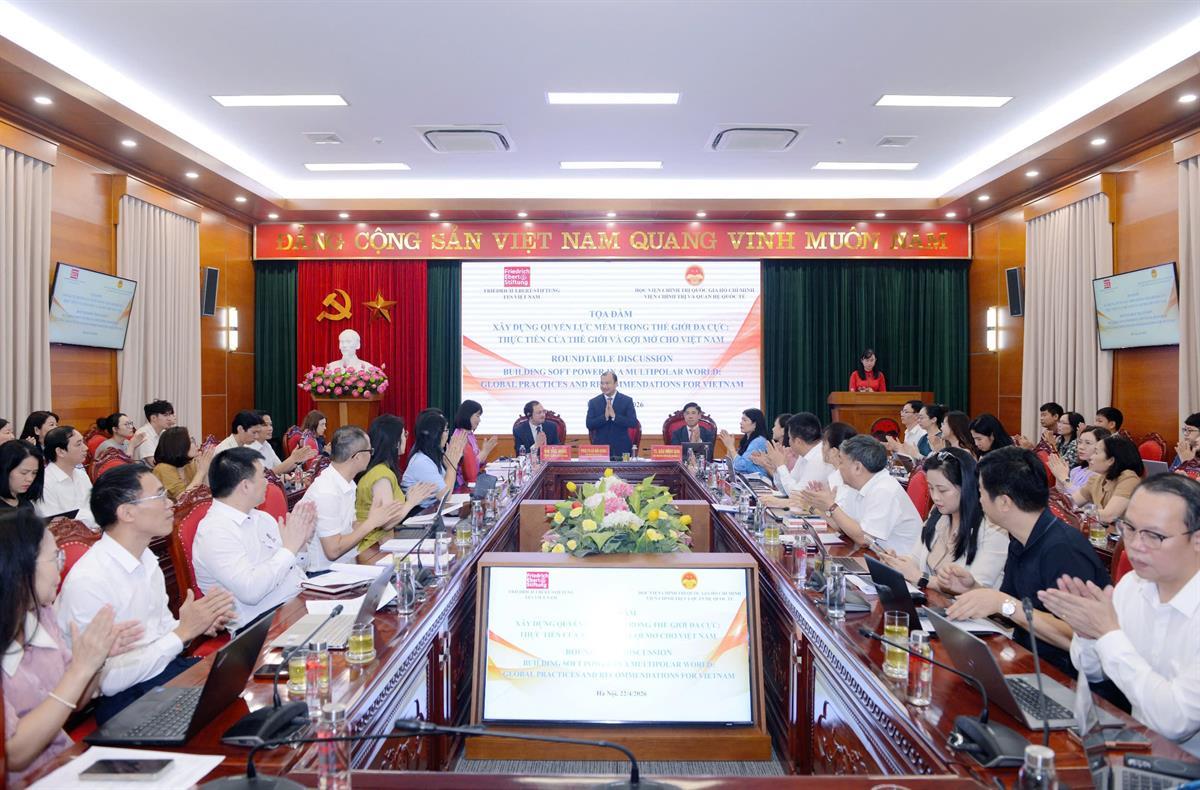 A view of the roundtable discussion
The event was organized into four working sessions with rich content and close integration of theory and practice. In the morning, the first session focused on clarifying the theoretical foundation and the transformation of soft power construction methods in a multipolar world context, with presentations on theoretical and practical issues, the impact of the scientific and technological revolution, and the current shift in soft power competition methods. The second session provided in-depth analysis on international experiences, notably the US strategy of promoting soft power through the global technology ecosystem and the Chinese soft power model, thereby offering insights for Vietnam.
The discussion continued with two key working sessions in the afternoon. Among them, the third session focused on analyzing trends in soft power building by international actors, clarifying the role of middle-sized countries and the rise of global Southern countries in a multipolar world, combined with in-depth discussions among the participants. The fourth session addressed strategic issues for Vietnam, including assessing Vietnam’s soft power position within ASEAN, identifying potential and resources, and proposing directions and solutions for development until 2030, with a vision to 2045.
At the event, the participants engaged in open, frank, and constructive debates in a rigorous scholarly spirit, focusing on the core issues raised in each presentation. Many questions and suggestions were raised and answered promptly, thereby contributing to clarifying theoretical arguments and verifying observations from international and domestic practices. The opinions went beyond analyzing the current situation and delved into assessing the trends of soft power in a multipolar world, thus suggesting new approaches in identifying resources, implementation methods, and policy mechanisms. The results of the discussion contributed to supplementing important scientific and practical foundations for formulating strategies to enhance Vietnam’s soft power, meeting the requirements of development and integration in the new era./.