The co-chairmen of the event were Assoc. Prof. Dr Hoang Phuc Lam, Deputy Secretary of the Party Committee cum Vice President of Ho Chi Minh National Academy of Politics and Dr. Nguyen Thi Thanh Nhan, Director of the Political Schools Department. The participants of the seminar included leaders of units under the Academy, scientists, experts, and lecturers in the field of cadre training and development; leaders of provincial and municipal political schools; representatives of local Party committees and authorities; and cadres working at the commune and ward levels.
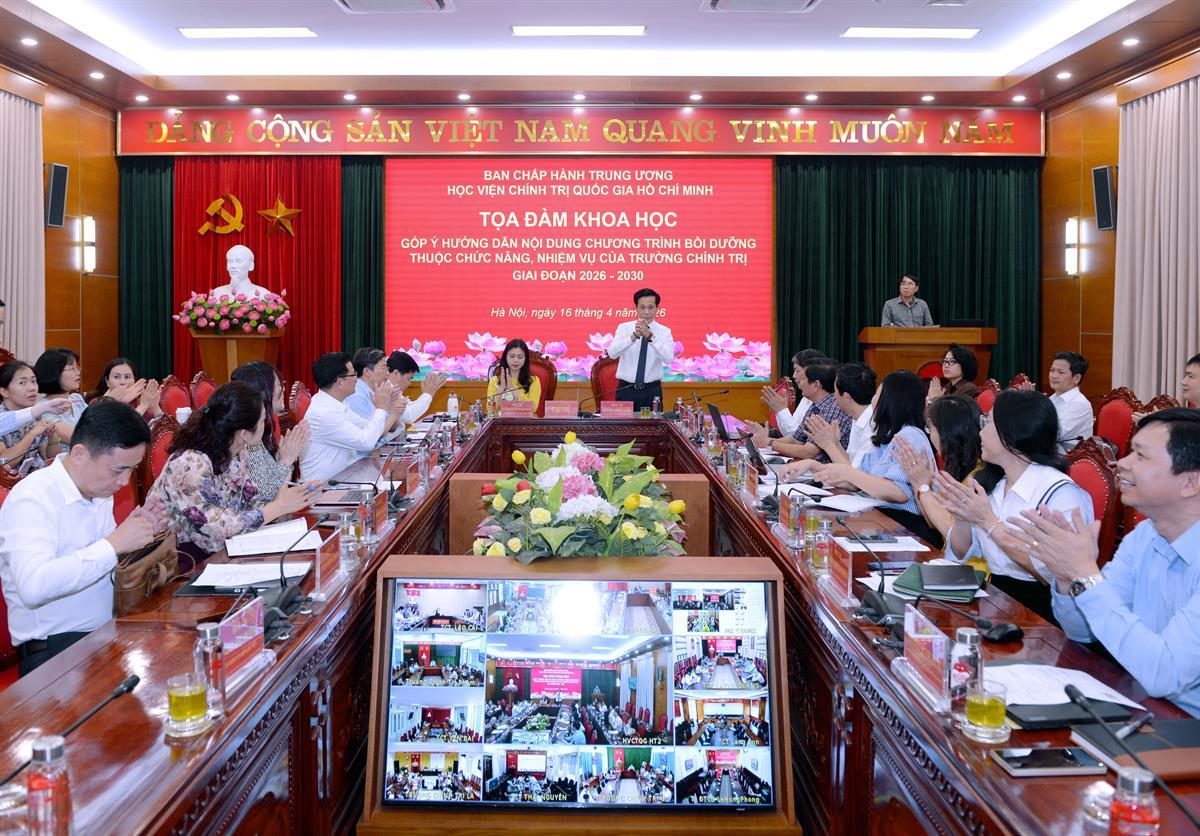 A view of the seminar
In her introductory speech at the seminar, Dr. Nguyen Thi Thanh Nhan emphasized that the context of transitioning to a two-tiered local government model is placing unprecedented and transformative demands on cadre training and development, especially at the commune level – the level that directly organizes the implementation of the Party’s guidelines and policies and the State’s laws and regulations. Accordingly, the requirement is no longer limited to expanding training content, but rather focuses on building a unified, standardized program capable of being implemented synchronously throughout the entire system of political schools.
Based on its assigned functions and tasks, the Academy plays a central role in guiding and unifying the management of training programs, content, and methods for cadre training. This requires the Academy to establish a sufficiently clear and flexible guiding framework for provincial political schools to apply proactively, ensuring system-wide consistency while remaining appropriate to the conditions and specific characteristics of each locality.
Emphasizing the innovative approach, Dr. Nguyen Thi Thanh Nhan said that the draft guidelines for developing training programs are not designed to simply list content, but rather to focus on logically building programs based on a competency-based approach, linked to job positions and practical requirements. Simultaneously, the Academy has proactively developed 11 training programs for key positions at the commune level, serving as “standard models” for political schools to refer to, thereby unifying the approach, design, and implementation of the programs.
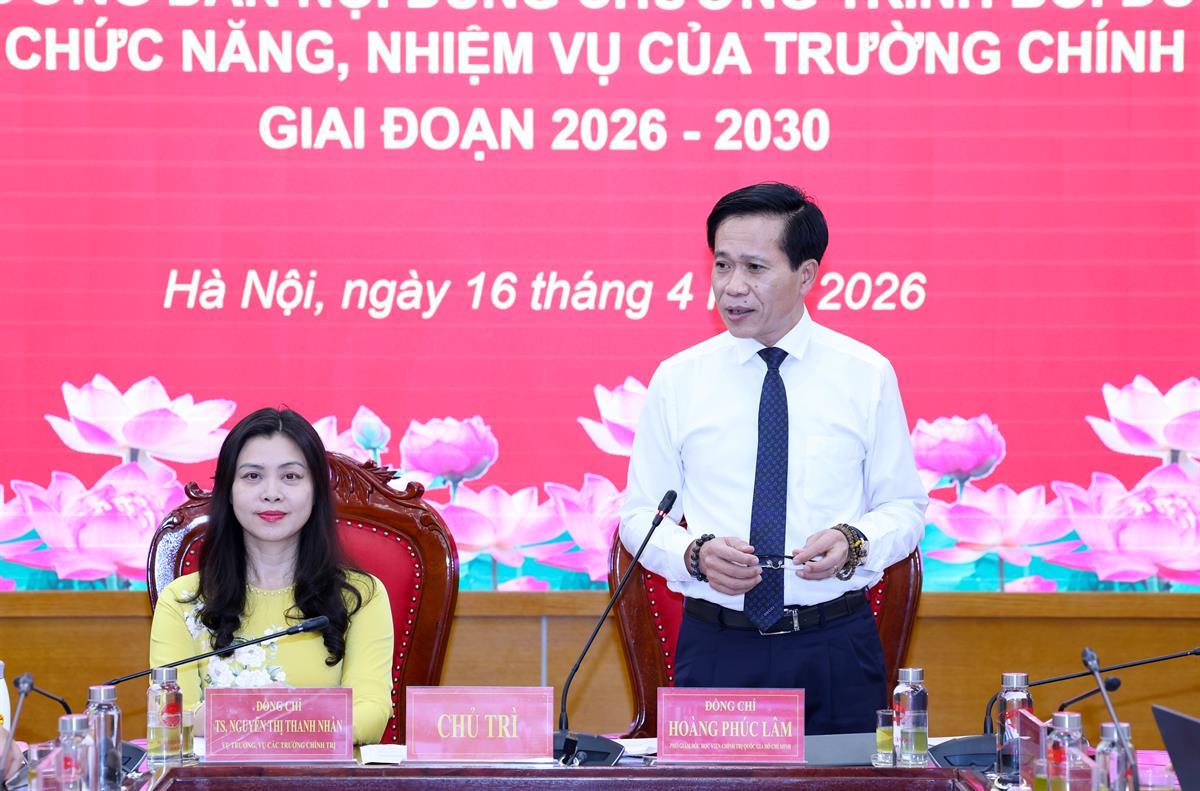 Assoc. Prof. Dr. Hoang Phuc Lam delivered a speech at the seminar.
Notably, all programs are designed with a unified structure comprising three components: foundational knowledge; job-specific knowledge and skills; and a practical component in connection with case studies and output products. The thematic system is organized into major content groups, ensuring a shift from “text introduction” to “how-to guidance”, and from “knowledge transmission” to “capacity building” for implementation among grassroots officials.
According to Dr. Nguyen Thi Thanh Nhan, from an organizational perspective, the classroom is no longer a one-way space for knowledge transmission, but is designed as a “management simulation” at the commune level, where learners directly handle situations, work in groups, develop plans, and finalize products during the learning process. This is not just a change in teaching methods, but a transformation in how competencies are formed, ensuring that after the course, learners can directly apply what they have learned to their practical work.
At the seminar, the participants focused on discussing and unanimously agreeing that finalizing the draft guidelines and the training program system is not only a technical requirement, but also a crucial shift in thinking regarding the organization of training and professional development for grassroots-level officials.
Based on that foundation, they concentrated on analyzing and deepening the approach to curriculum development based on competence, linked to job positions and practical requirements. Many opinions emphasized the need to clearly establish core “framework” principles to ensure uniformity throughout the system, while maintaining the necessary flexibility to allow political schools to proactively adapt to the characteristics and requirements of each locality. This is seen as a balance between standardization and flexibility — a fundamental requirement in the current context of reform.
Regarding the 11 training programs developed by the Academy, the participants centered on providing their feedback on further standardizing the structure, clarifying the specific characteristics of each job title, avoiding duplication of content, and enhancing the interconnectedness between programs. Particularly, many opinions suggested further improving the practicality and the level of “relevance to the job”, ensuring that each program not only provides knowledge but also aims for direct application, helping trainees effectively handle situations arising in their work.
One area that received particular attention was the innovation in training methods. The participants expressed strong consensus on the orientation of taking practice as the core, viewing the classroom as a simulated environment of commune-level governance activities. Therefore, it is necessary to increase the time allocated to case studies, teamwork, and the development and defense of proposals while also redefining the role of lecturers from knowledge transmitters to facilitators, with standardized thinking and methods.
Many opinions also highlighted the need to improve learning assessment mechanisms in a way that closely linked outcomes with learners’ implementation capacity, considering output products and the ability to apply knowledge in practice as the primary benchmarks. This is seen as an important condition for ensuring the substantive quality of training and development, avoiding formalism and overly theory-heavy approaches as in the past.
From multidimensional perspectives, the participants unanimously agreed that the renewal of the training programs and methods is not merely aimed at improving a set of documents or a number of specific programs, but rather at building a modern, unified training system capable of effective implementation and of generating real implementation capacity for commune-level cadres in the new development stage.
In his concluding remarks, Assoc. Prof. Dr. Hoang Phuc Lam acknowledged and expressed sincere appreciation for the dedicated and responsible contributions of experts, scholars, and managers at the seminar. The opinions closely reflected practical realities and focused on core issues, helping to further clarify many important contents in the draft guidelines as well as the system of 11 training programs developed by the Academy. At the same time, they contributed to shaping a new approach to the entire system of cadre training and development within the political school system in the coming period. Assoc. Prof. Dr. Hoang Phuc Lam requested the drafting committee to fully incorporate all feedback to further refine the draft guidelines and the system of 11 training programs, ensuring they meet the requirements for uniformity throughout the system and are capable of effective implementation in practice; becoming the foundation for a new system of cadre training.