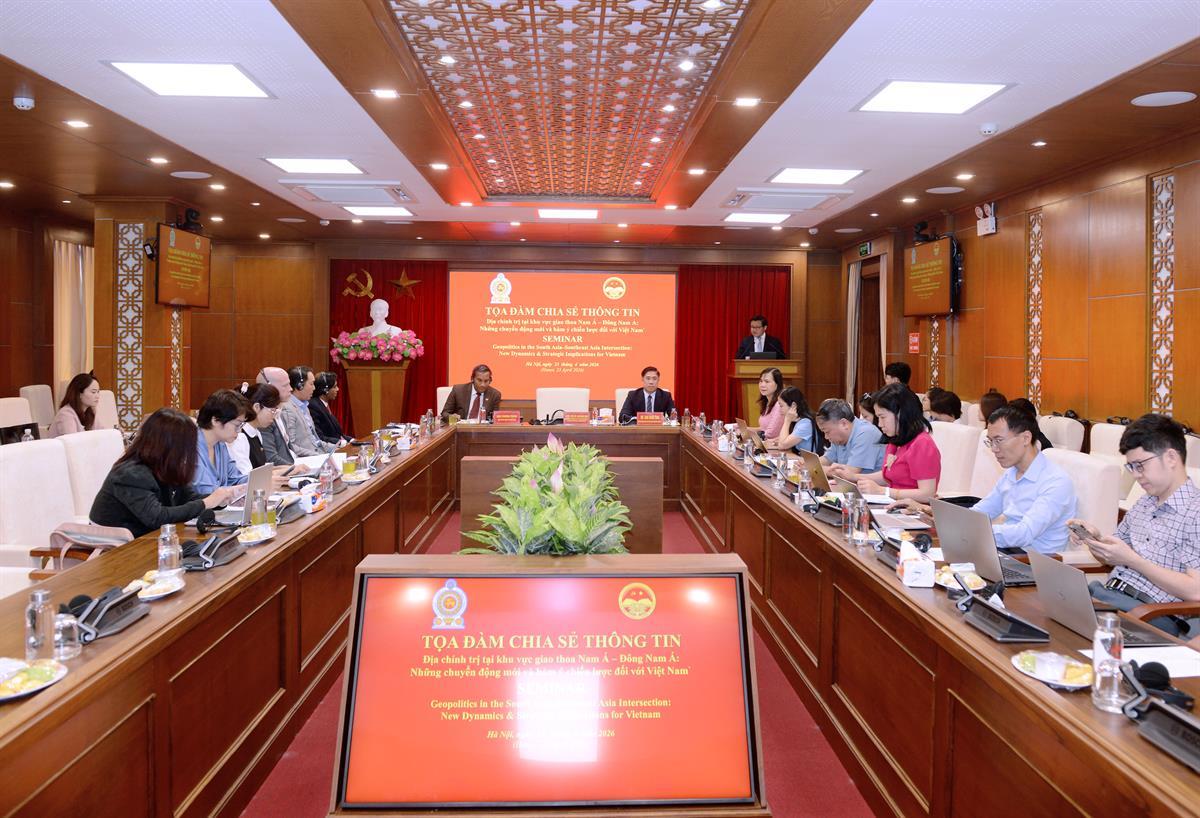
 Overview of the event
Attending and chairing the seminar were H.E. Poshitha Perera, Ambassador of Sri Lanka to Vietnam; Assoc. Prof. Dr. Dau Huong Nam, Director General of the Department of International Cooperation; and Dr. Dao Ngoc Bau, Director of the Institute of Politics and International Relations. The event was attended by officials, lecturers, and researchers from the Institute of Politics and International Relations and the Department of International Cooperation.
Prof. Asanga Abeyagoonasekera, Executive Director of the South Asia Foresight Network (SAFN), served as the keynote speaker.
Transformative Characteristics of Contemporary Geopolitics
At the seminar, Prof. Abeyagoonasekera presented findings from three years of research, published in the international work Winds of Change. The studies argue that geopolitics is no longer confined to conference rooms or strategic theories. Instead, it unfolds quietly in seaports, markets, and even in the everyday calculations of ordinary people.
According to the research, the Indo-Pacific region is not merely an arena of competition among major powers but also a space where geography and strategy intersect. Today, this convergence has taken on a more direct and human dimension. Geopolitics is increasingly experienced not first by states, but by individuals.
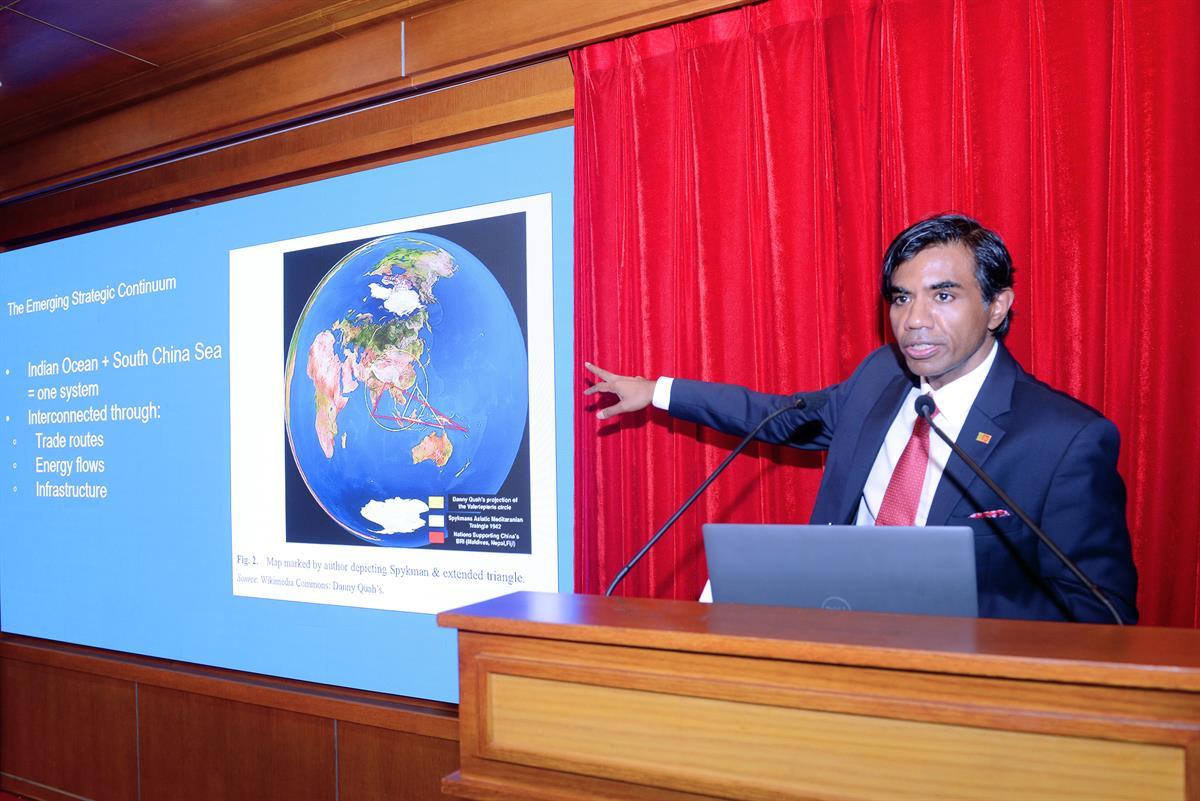 Prof. Asanga Abeyagoonasekera speaks at the event
Prof. Abeyagoonasekera noted that South Asia and Southeast Asia were once viewed as two distinct geopolitical spaces. However, this perspective is no longer adequate. The Indian Ocean and the South China Sea have become part of a single strategic system. Trade routes, energy flows, and strategic infrastructure have connected the two regions so closely that disruptions in one area immediately affect the other.
For example, developments in the Strait of Hormuz generate widespread impacts through price shocks, supply chain disruptions, and economic instability. Modern warfare is no longer expressed solely through missiles but also through rising prices and shortages. Stability, once taken for granted, has become conditional. This represents a defining transformation of contemporary geopolitics.
Nevertheless, according to Prof. Abeyagoonasekera, the most significant shift concerns people rather than strategy. Across the Indo-Pacific, geopolitical shocks are reflected not through official statements but through reduced working hours, rising living costs, and growing concerns over economic security. While power may be exercised globally, its consequences are deeply local and regional. Therefore, geopolitics should be understood not only as the art of statecraft but also as a lived human experience.
Strategic implications for Vietnam
Within this context, Prof. Abeyagoonasekera emphasized the increasingly important role of Vietnam as an emerging middle power. Facing both domestic structural challenges and the intensifying strategic competition between the United States and China, Vietnam has placed geopolitical autonomy and deep international integration at the center of its strategy.
This is not a traditional policy of neutrality but rather a deliberate strategy of multi-alignment—actively engaging with major powers while avoiding the necessity of choosing sides.
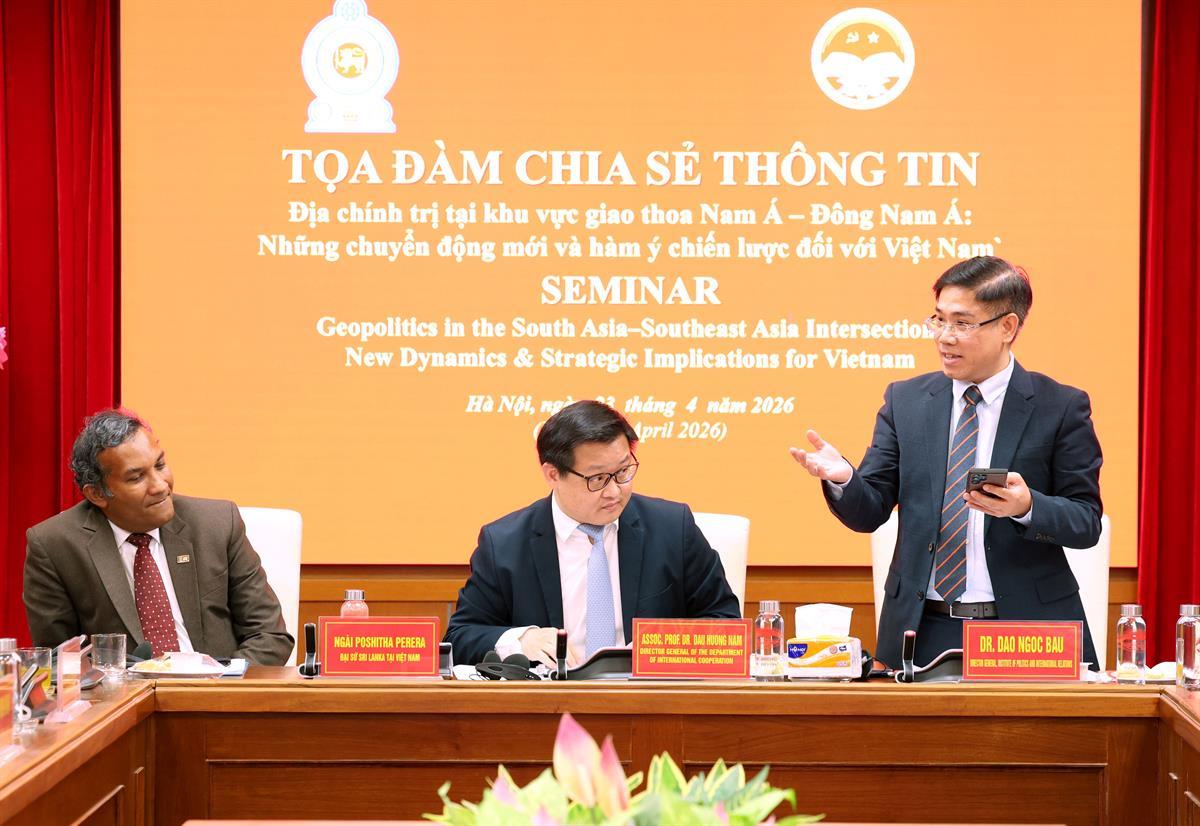 Delegates chair the event
To navigate an increasingly uncertain environment, Vietnam must strike a careful balance between growth and resilience. Economic modernization should move beyond dependence on external drivers and focus on strengthening domestic capabilities. Enhancing technological capacity, particularly in digital technologies and the semiconductor industry, offers a pathway toward higher value-added growth.
At the same time, energy transition—especially the development of renewable energy—represents both an urgent necessity and a strategic opportunity, positioning Vietnam as a potential regional energy hub. Geopolitics, trade, technology, and energy are not separate domains; rather, they constitute interconnected pillars of Vietnam’s future strategic development.
About Winds of Change
Winds of Change examines China’s Belt and Road Initiative, India’s foreign policy under Prime Minister Narendra Modi, and the United States’ Indo-Pacific Strategy.
Drawing upon field research, travel experiences, exclusive interviews, and in-depth analysis, the book explores four key themes: the geopolitics of the Belt and Road Initiative, India–China regional diplomacy, geopolitical power competition, and Sri Lanka’s domestic political challenges.
The work analyzes how countries such as Thailand, Cambodia, Singapore, and Vietnam are adapting to shifting power dynamics, as well as how Sri Lanka, Bangladesh, Pakistan, the Maldives, and Nepal seek to maintain balance amid India–China tensions. Central questions include how South and Southeast Asian countries perceive the regional diplomacy of India and China, and how India–China tensions affect Sri Lanka and regional stability.
Building upon the geopolitical theories of Nicholas J. Spykman and contemporary scholars, Winds of Change combines historical and modern geopolitical analysis to provide valuable insights into a region that lies at the center of twenty-first-century power competition. The book serves as an important reference for policymakers, scholars, and those interested in global affairs.