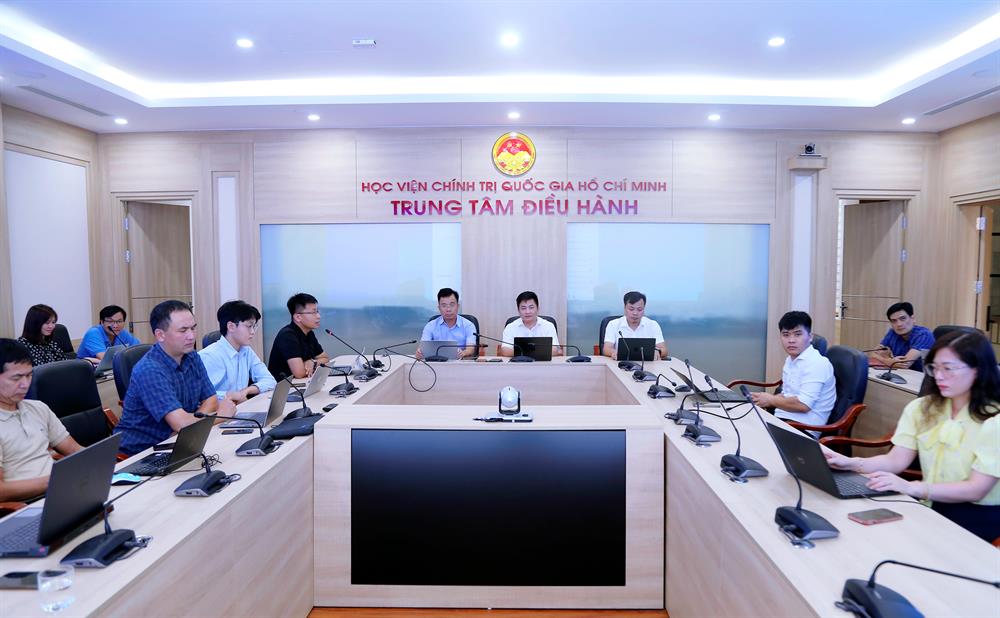
Scene of the seminar
The seminar was organized to exchange views and clarify the potential for applying AI models operating in internal environments to support management, research, teaching, learning, and the handling of professional tasks; while also assessing requirements concerning data security, technical infrastructure, integration capacity, and implementation effectiveness under the Academy’s actual conditions.
At the seminar, delegates were introduced to the AI Local solution – an artificial intelligence assistant model installed and operated directly on personal computers or internal systems, without being entirely dependent on Internet connectivity or external cloud computing platforms.
According to the presentation, while the use of cloud-based AI tools currently offers many conveniences, it also raises a number of issues requiring attention, particularly the risk of leakage of internal documents and sensitive information; dependence on Internet connectivity; usage costs based on data volume or the number of queries; as well as the ability of agencies and units to control their systems and data. In this context, researching internal AI solutions is of practical significance for agencies with high requirements for information security, safety, and data sovereignty.
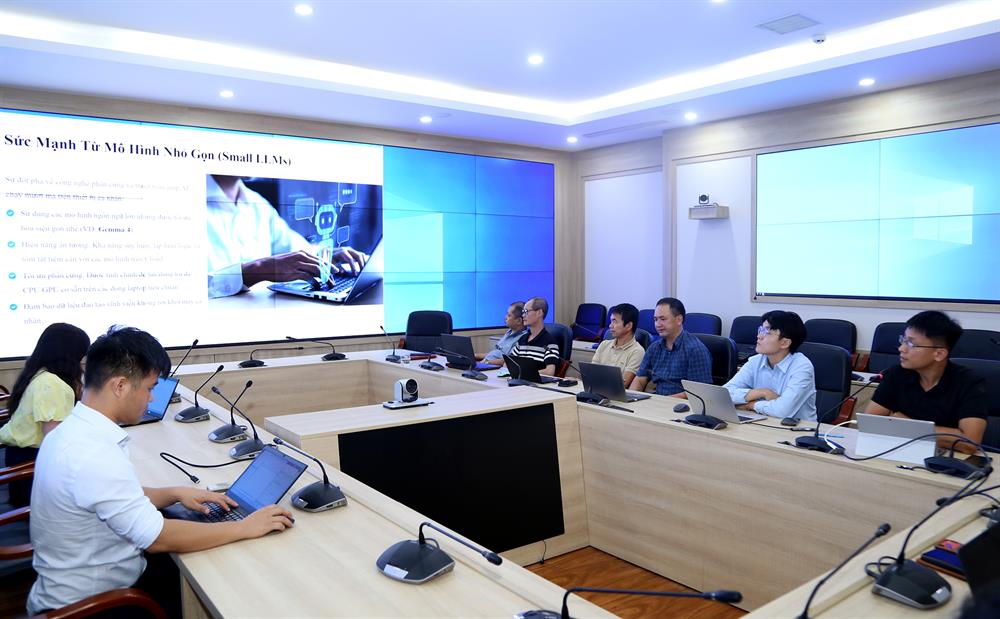
The seminar on the application of internal AI in work
The AI Local solution enables users to upload professional documents for retrieval, question answering, analysis, and content synthesis directly from the provided data sources. The entire process of indexing, understanding, and processing information is carried out on the device or within internal infrastructure, helping limit the transfer of documents to external servers. The solution can support various data formats, including PDF, DOCX, PPTX, audio, and video files, while also providing answers accompanied by citations from the original documents.
The system operates through several basic steps: receiving documents; indexing and processing data using a local language model; interacting and asking questions in natural language; and automatically generating summaries, outlines, review questions, reports, and other synthesized products. The interface is designed to be intuitive and user-friendly, allowing users to work with the system by dragging and dropping documents and interacting directly with it.
Potential applications at the Academy
At the seminar, delegates focused on discussing the potential application of internal AI to specific tasks at the Academy. In teaching and research, this technology can support the synthesis of materials, development of lecture outlines, question-and-answer systems, summarization of research works, and rapid retrieval of information from learning-resource repositories. For cadres and staff members, an AI assistant can support document analysis, report synthesis, retrieval of regulations, preparation of drafts, and the handling of routine tasks based on controlled data sources.
For learners, the system can contribute to personalizing review activities, answering questions based on textbooks, summarizing content, and developing knowledge systems by topic. In administration and management, the solution can be studied for integration with shared data repositories and knowledge bases to serve leaders, professional staff, and the Academy’s operational systems.
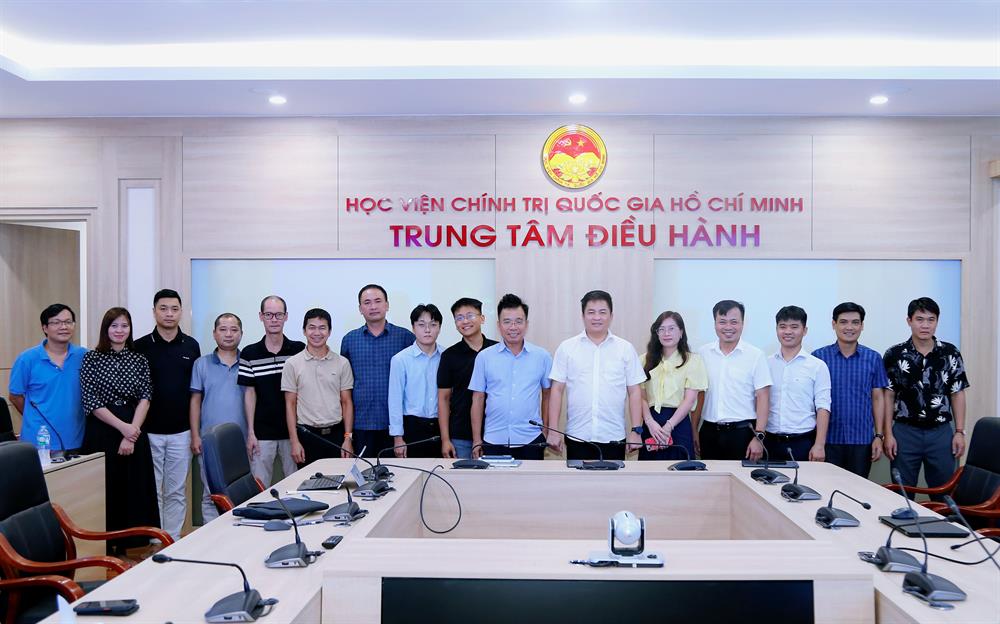
Delegates taking a group photo at the seminar
In addition to solutions installed on personal devices, opinions exchanged at the seminar also addressed the direction of developing a centralized data platform connecting operational data sources, document repositories, and analysis and reporting systems. This could provide a foundation for gradually building the Academy’s digital knowledge repository, enabling cadres, lecturers, and trainees to proactively access information quickly, accurately, and within their authorized scope.
Orientation for pilot implementation
Speaking at the seminar, Assoc. Prof. Dr. Tran Quang Dieu highly appreciated the contents exchanged and introduced by the experts. He stated that demonstrating the internal AI model and introducing several software features constituted an important initial step for the Center’s cadres and staff to directly access and learn about its operating mechanisms, data-processing capabilities, and the extent to which the technology could support their professional work.
Assoc. Prof. Dr. Tran Quang Dieu requested that the Center for Technology and Digital Transformation closely coordinate with the National Innovation Center and relevant units to develop a plan for pilot implementation of the software at an appropriate time. The pilot process should select specific scenarios and tasks; regularly collect user feedback; and objectively assess the system’s accuracy, stability, security, integration capacity, and effectiveness in supporting work.
Based on the pilot results, the Center will continue to coordinate with the Center in the coming period to test, finalize, and gradually improve the model, ensuring that the software becomes increasingly suited to the Academy’s specific operations. At the same time, the Center will study the possibility of applying AI models to administration and operations, as well as training and refresher training activities, initially focusing on tasks with clear feasibility and effectiveness while ensuring requirements for data security and information safety are met.