Scientific forum to further concretize the special Vietnam-Laos relationship
The conference is an annual theoretical research cooperation activity among the four leading research and training institutions in political theory of the two countries, held on a rotational basis to concretise the great friendship, special solidarity, comprehensive cooperation, and strategic cohesion between the two Parties and the two States. It also serves as a forum for providing a solid scientific basis for policymaking on socio-economic development and the building of an independent and self-reliant economy in each country in the new era.
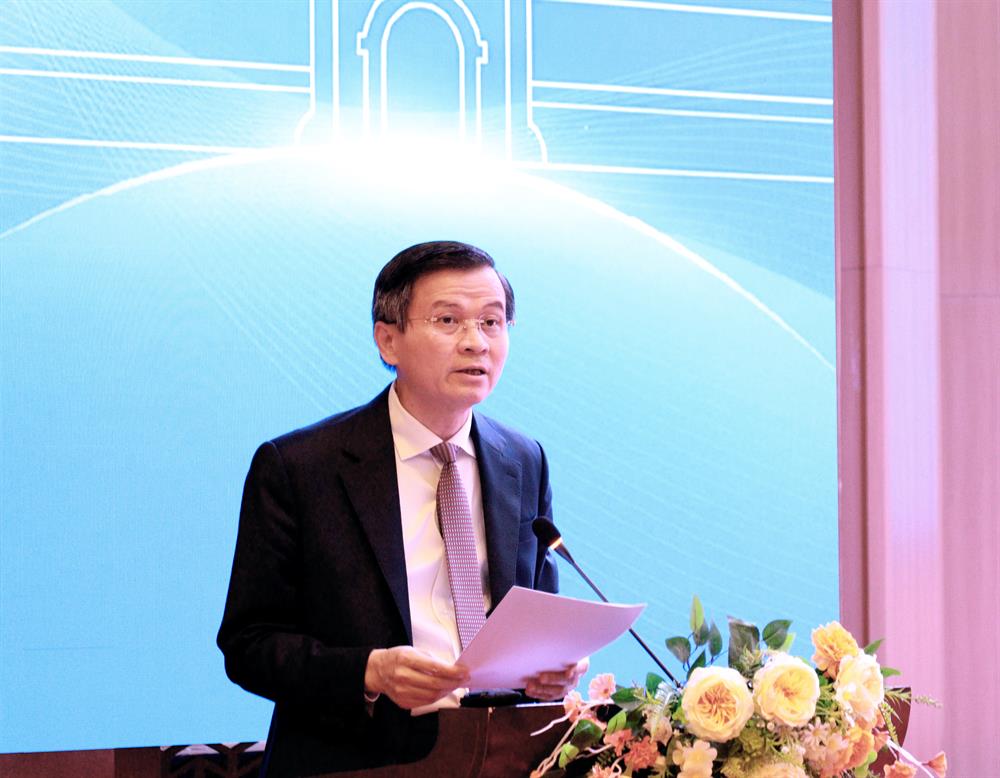
Assoc. Prof. Dr. Doan Minh Huan, Politburo member of the Central Committee of the Communist Party of Vietnam and President of the HCMA delivered the opening remarks at the conference
The conference was attended and co-chaired by leaders of the Communist Party of Vietnam and the Lao People’s Revolutionary Party, including Assoc. Prof. Dr. Doan Minh Huan, Politburo member of the Central Committee of the Communist Party of Vietnam and President of the HCMA, Dr. Anouphap Tounalom, Secretary of the Central Committee of the Lao People’s Revolutionary Party (LPRP) and President of the NAPPA; Dr. Leeber LeeBouapao, member of the Central Committee of the Lao People’s Revolutionary Party and President of the Lao National Institute for Economic and Social Sciences; and Prof. Dr. Le Van Loi, Member of the Central Committee of the Communist Party of Vietnam and President of the Vietnam Academy of Social Sciences, along with a large number of experts, scholars, and representatives of relevant Party committees, ministries, and agencies of the two countries.
In his opening remarks, Assoc. Prof. Dr. Doan Minh Huan affirmed that the world is undergoing rapid, profound, and unpredictable changes. Strategic competition, geopolitical conflicts, trade protectionism, climate change, and non-traditional security risks are directly affecting economic stability, energy security, food security, and global supply chains. At the same time, artificial intelligence, digital transformation, and the green transition are reshaping modes of production, market structures, and the position of each country.
In this context, building an independent and self-reliant economy, coupled with proactive, comprehensive, and effective international integration, is not merely a development choice but also a condition for firmly safeguarding each country’s political independence, national defence, security, foreign relations, and right to self-determination.
He emphasized that the conference focuses on three key pillars of cooperation for the coming period: (i) renewing approaches and models for strategic Vietnam-Laos economic connectivity; (ii) leveraging synergies in institutional capacity, policy implementation, and macroeconomic risk management; (iii) elevating theoretical research cooperation and strategic policy advice among the four institutions. These pillars provide the overarching analytical framework guiding the discussions throughout the conference sessions.
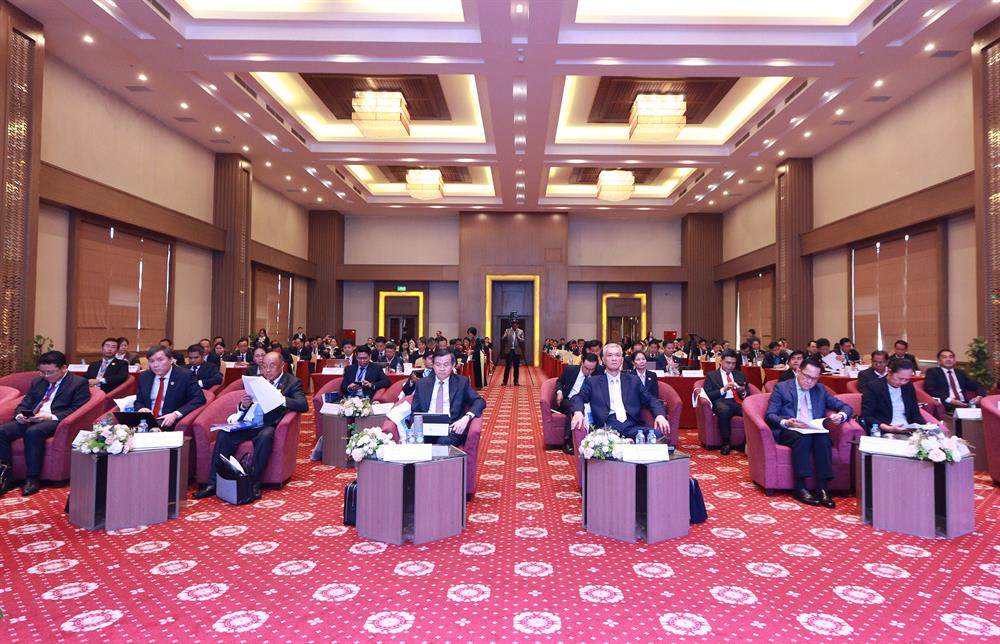
Overview of the conference
The conference was held in four sessions. The Lao presentations focused on clarifying the context, necessity, objectives, and implementation orientations of Resolution No. 04 of the Politburo of the Central Committee of the Lao People’s Revolutionary Party on building an independent and self-reliant economy; analysing the leadership role of the Lao People’s Revolutionary Party in developing an independent and self-reliant economy; and proposing solutions concerning fiscal policy, public debt management, creating fiscal space for development, and improving the quality of human resources.
Drawing on a systematization of theoretical perspectives and a review of 40 years of the Doi Moi process, Vietnamese scholars shared experiences in building an independent and self-reliant economy while pursuing deep international integration and steadfastly maintaining the socialist orientation. A common point across the presentations was that independence and self-reliance do not mean isolation or economic self-sufficiency. Rather, they entail the capacity to determine the country’s own development path and approach and to safeguard the Fatherland, while proactively participating in global value chains.
Experts from the two countries engaged in frank exchanges on the feasibility of the proposed approaches, as well as the similarities and differences in the natural and social conditions of the two countries. Many participants agreed that Vietnam’s experience in developing a socialist-oriented market economy, science and technology, innovation, the digital economy, and the green economy, among other areas, offers valuable reference for Laos in translating Resolution No. 04 into practice. Based on the exchanges and discussions, the scholars proposed solutions to renew approaches and models of strategic cooperation; create synergies in institutional capacity and policy risk management; elevate theoretical research and policy advisory cooperation between the two countries; and strengthen theoretical cooperation to deepen understanding of the theoretical and practical issues arising from the development of both countries.
Cooperation orientations
At the conclusion of the conference, the leaders of the four scientific institutions of the two countries held talks, highly valued the substantive outcomes achieved, and agreed on the theme of the 2027 annual international scientific conference, to be organized on a rotational basis, with the Vietnam Academy of Social Sciences serving as the host institution.
In his concluding remarks, Assoc. Prof. Dr. Doan Minh Huan affirmed that theoretical cooperation should contribute to deepening understanding of the path toward socialism in each country; strengthening ideological foundations, political resolve, and national self-determination; and proactively countering erroneous and hostile views, as well as narratives that distort and seek to undermine the special solidarity between Vietnam and Laos.
He emphasized that the value of cooperation among the four institutions lies in the quality of the scientific evidence, the persuasiveness of policy recommendations, and their substantive contribution to the development of the two countries.
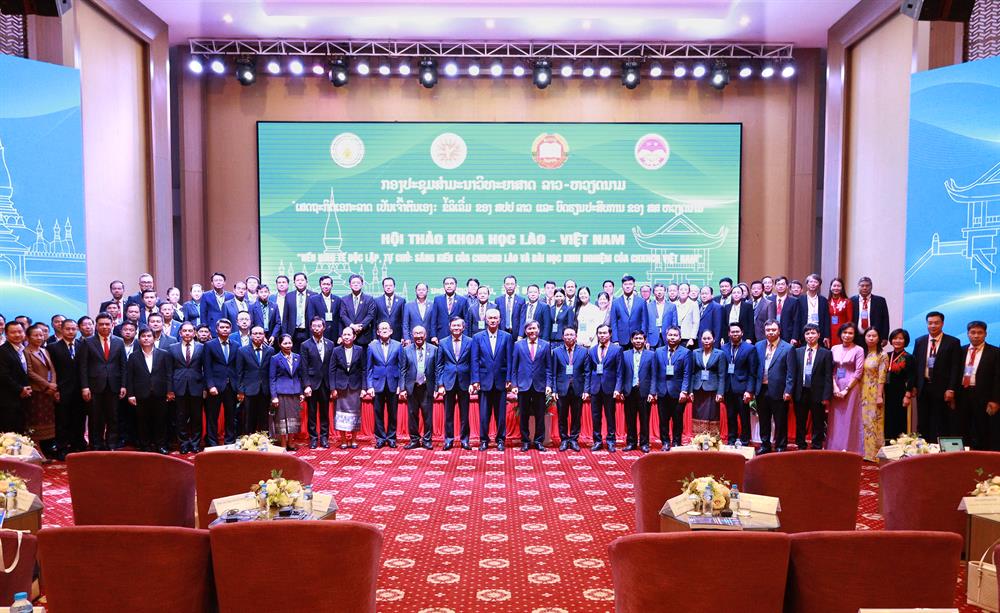
Delegates took a group photo at the conference
News: Institute of Political Economy; Photos: Anh Tuyet