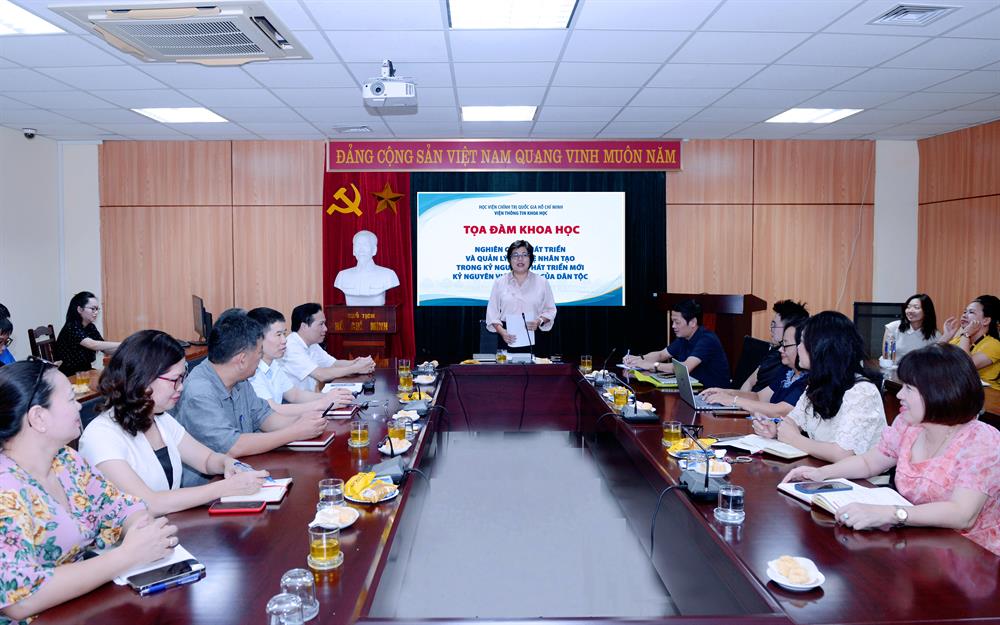
Dr. Pham Thi Thanh, Director of the Institute of Scientific Information, delivered the opening remarks at the discussion
The discussion was attended by scientists, experts, and researchers from within and outside the Academy. It provided an opportunity for scientists, policymakers, and experts to exchange and share research findings, practical experience, and emerging issues, thereby proposing appropriate solutions for the research, development, governance, and effective application of artificial intelligence (AI) in the new context.
In her opening remarks, Dr. Pham Thi Thanh emphasized that in recent years, AI has developed at a rapid pace, becoming one of the technologies with far-reaching impacts on socio-economic life. AI is not only changing modes of production, governance, and the organization of social life, but is also bringing about fundamental transformations in scientific research, education, communications, public governance, and many other fields.
For Vietnam, Resolution No. 57-NQ/TW dated December 22, 2024, of the Politburo identifies the development of science and technology, innovation, and national digital transformation as the foremost major breakthrough, creating a driving force for the development of modern productive forces, renewing national governance methods, and laying the foundation for the country’s breakthrough development.
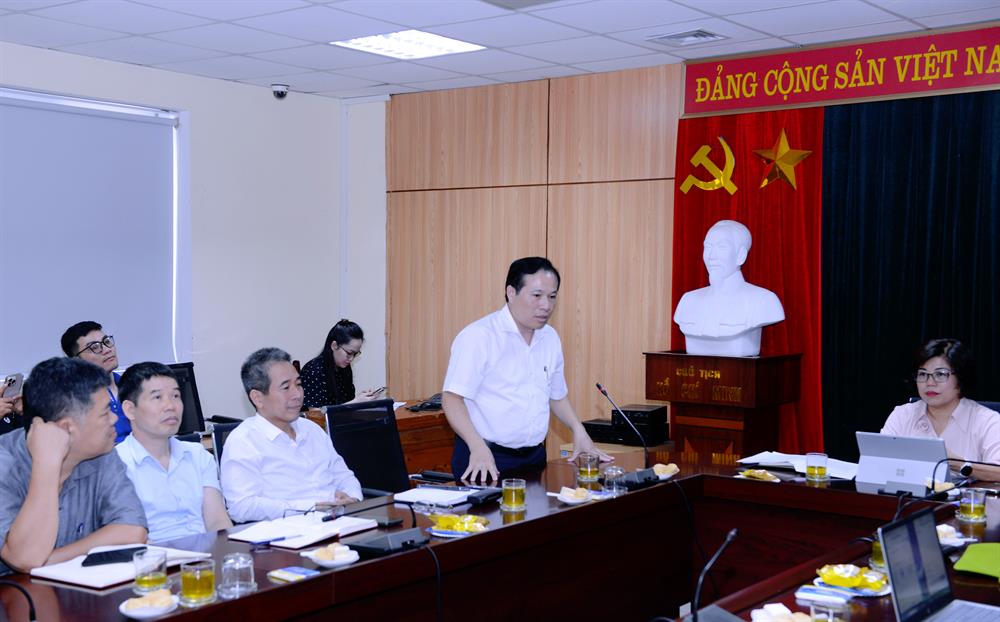
Delegates presented papers at the discussion

Delegates presented papers at the discussion
According to Dr. Pham Thi Thanh, alongside the major opportunities, AI also poses a wide range of new issues that need to be identified and addressed, including the capacity to master technology; the quality of human resources; data and infrastructure serving AI; the improvement of institutions and governance mechanisms; the assurance of safety, security, and data sovereignty; and the control of risks. At the same time, AI raises requirements concerning ethics, culture, and humanity.
According to Dr. Pham Thi Thanh, as the country enters a new development era, the issue is not merely to expand the scale or increase the pace of AI application, but, more importantly, to determine how AI should be researched, developed, and governed so that the technology genuinely serves people and the country’s development, safeguards national interests, and is compatible with the cultural and ethical values of Vietnamese society. This is also a guiding requirement underlying the discussions at the discussion.
In their presentations, the speakers approached the issue of AI from different but closely interconnected perspectives, focusing on AI governance in political-theoretical scientific information activities; journalism and publishing; the social responsibility of the press in applying AI; and the role of Vietnamese-language journalistic data in national AI development.
According to the presentations, AI is an important achievement of modern science and technology; however, technology itself does not automatically generate development. The value and effectiveness that AI brings depend first and foremost on the capacity to master technology, the quality of institutions, governance capacity, and, in particular, people’s ability to guide, control, and use technology. Therefore, research, development, and governance of AI need to be approached from a comprehensive perspective, ensuring a balance between promoting innovation and managing and controlling risks, as well as between harnessing the benefits of technology and protecting people, ethical and cultural values, and national interests.
The issues raised at the discussion demonstrated that AI development cannot be approached solely from a technological perspective, but must be closely linked with institutions, governance, data, human resources, and the social value system. In this process, people must remain at the center of guiding, controlling, and determining how technology is used; innovation must at the same time be associated with social responsibility, ethics, and the imperative to safeguard national interests.
Through the presentations and exchanges of views, the discussion contributed additional scientific and practical grounds for research and advisory work, while providing a more comprehensive understanding of the issues arising in the research, development, governance, and application of AI in Vietnam today. Thereby, it contributed to promoting the effective utilization of AI achievements in service of scientific research, political-theoretical information, and journalism, in line with the country’s development requirements in the new era.
Editorial Board